
PRODUCT MARKET
Electronic Health Records (EHR) is a specialized segment of Healthcare data and technology, with a global market value of approx. $28b. Patient records serve as the basis for all proceeding Healthcare workflow priorities. Serving a fundamental role in the distinct domain of care-management, records administration, claims validation and adjudication. As a fundamental clinical requirement, the customer-base spans the care-provider domain. The client-base generally is dominated by care-organizations, retaining SaaS License contracts.
EHR systems are fundamental to care-providers for navigating both patient-care and operating a Healthcare business. Vendor offerings range from general purpose to specialized EHR’s modeled and designed for specific care Specialty domains.
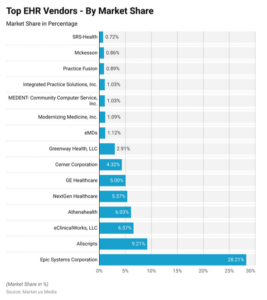
Whereas, there are 400+ EHR vendors commercially operating within the Patient Records space. For this reason, the EHR technical environment is silo’d and subjectively proprietary. This market characteristic is the core distinction between an EHR and Interoperability.
Health Information Exchanges (HIE) constitute the next tier in the EHR domain. There are 130+ HIE’s nation-wide of both specialized and regional scopes, existing in-part to solve the issue of Interoperability. HIE’s are essentially infrastructure components of the Healthcare data ecosystem, with an enterprise and institutional client-base. Primarily, their purpose is facilitating individual patient-care validations for claims adjudication.
The scope and reach of each HIE is generally determined by its respective subscriber base. Additionally, HIE’s are limited by HIPAA related restrictions and disclosure authorizations for Protected Health Information (PHI). HIE’s partially address Interoperability issues, but have long proven insufficient and arguably contribute to segmentation.
EHR and HIE customers are primarily enteprise-level care-orgs, with clinical practitioner and office level instances. The pervasive business-model being SaaS model enterprise Licenses for client defined user populations and access control.
Given this technical and commercial landscape, portable Interoperability is a distinct, valuable functional capability, differentiated from the existing stakeholders.
Kno | bility specializes in interoperability across the span of varying EHR’s with an application-based approach for individual Provider and Patient user’s. Differentiating itself from full-fledge enterprise software solutions requiring full infrastructural integrations, i.e. Kno | bitity ProvidEHR App.
BUSINESS CASE
Market Assessment
Electronic Health Records (EHR) are a complex issue, given the convoluted technical ecosystem defining the corresponding infrastructure. Acknowledged interoperability issues are attributed to this complexity. This has an identified impact on essential business priorities of Care-Providers, EHR’s serving as the basis for validations and remittances.
According to the broadest Healthcare statistical measures, there are:
- 33,679,935 – Admissions
- 6,120 – U.S. Hospitals
- 989,320 – Physicians
which constitute the size and scale of the U.S. Healthcare system.
As a consequence, overall records quality and comprehensive sourcing has substantive value as a functional capability, having dove-tailed into it’s own commercialized [top-heavy] segment. Present enterprise-oriented methodologies are costly and burdensome for care-organizations and providers.
Presently, Market.us Media estimates the EHR Global market value as approxmately $27b, with projected growth to $45b by 2033.
96% of U.S. care-providers have adopted Electronic Health Records (EHR) systems, models and methodologies. Despite this pervasiveness, it’s the very parsed commercial lanscape and corresponding segmented technical infrastructure which validates Kno | bility’s core product value; simple, portable, practical EHR interoperability APP.
Market Environment
A specialized industry defined by infrastructure level enterprise solutions.
Electronic Health Records (EHR) is a $30b market with 400+ vendors.
‘EHR Interoperability’ is a specialized functional capability parsed between:
400+ Electronic Health Record (EHR) vendors with 96% adoption rate – utilizing any form of EHR
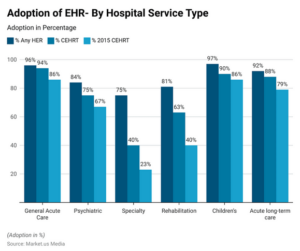
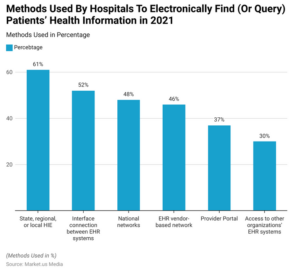
and, 130+ HIE’s segmented by region, subscribers, specialty are utilized by 61% of hospitals.
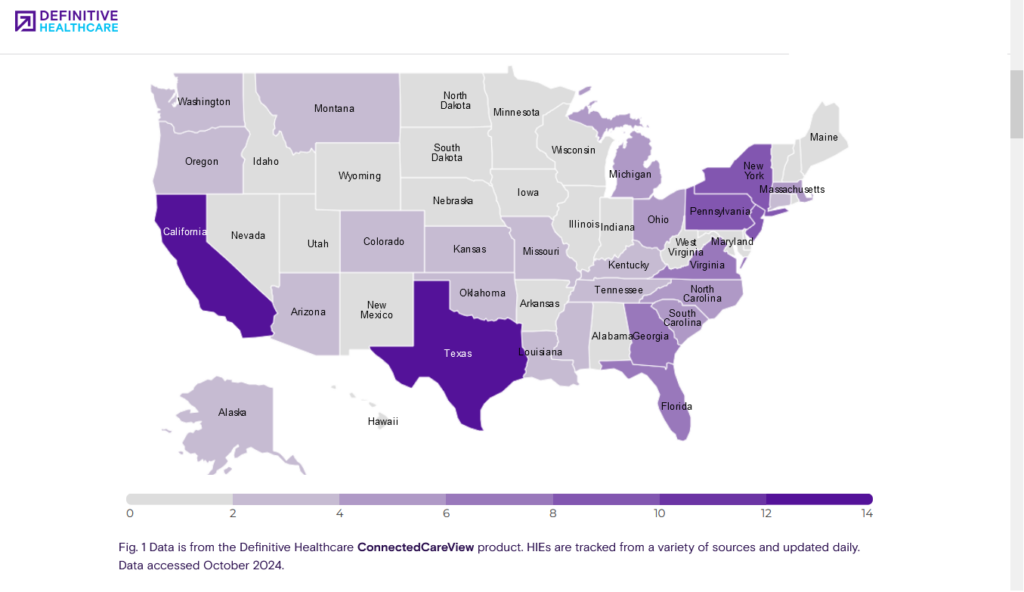
Every client instance leverages their respective EHR system and data-model differently. In-general, NO two systems are the same. (Anecdotally: this is the basis for M&A related issues, and barriers to the VA $10B tech refresh)
These sprawling approaches neccessitated the composition and institution of correlating digital standards. However, inherent complexities result in persistent postponements of compliance requirements, due to widely varying ground-level, utilization issues (new standards adoption compliance due-date is 2028).
[*for reference:
Health Information Technology for Economic and Clinical Health (HITECH) Act sets the framework for EHR adoption, interoperability and ‘meaningful use’.
21st Century Cures Act mandates patient access to their health information, prohibits information blocking.]
An overall clinical, care and business value of accurate, quality, comprehensive electronic Patient records is demonstrated in the outcomes reported by Providers. Validated in 1st-hand Outcome Statistics, implementation of Electronic Health Records (EHR) significantly improve:
- Access to critical information, which has seen the most substantial enhancement, with an 80% improvement, facilitating timely and informed decision-making in patient care.
- Preventive care adherence has increased by 30%, underscoring the role of EHR in promoting routine health maintenance and early intervention.
- Hospital readmissions have also decreased by 30%, indicating better patient monitoring and follow-up care.
- Chronic disease management has improved by 25%, reflecting more effective tracking and treatment of long-term conditions.
- Additionally, medication errors have been reduced by 48%, highlighting the EHR’s ability to enhance accuracy in prescribing and administering medications.
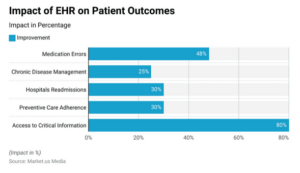 (source: MEDIA MARKET Research – citing; Journal of General Internal Medicine, Health Affairs, The American Journal of Medicine)
These improvements collectively demonstrate the positive impact of EHR care info on the quality and efficiency of healthcare delivery.”
EHR Interoperability is a very-particular functional capability lagging within the records domain. According to recent Interoperability assessment statistics, despite 96% hospital participation, only 20% of Health Information Exchanges (HIEs) have achieved interoperability.
Identified Interoperability issues and challenges include:
- High implementation costs
- In 2021, just 46% of U.S. hospitals had adopted basic EHR interoperability
- Reportedly costs the healthcare system around $30 billion annually
- Interoperability issues between different systems
- Healthcare providers revealed that 53% face challenges with EHR interoperability
- Gaps contribute to patient safety issues, inadequate exchange cited in 20% of adverse events
- Concerns about data privacy.
Health Information Exchanges (HIEs): 96% hospital participation. 20% achieved interoperability.
(source: MEDIA MARKET Research)
Key interoperability issues cited in the most recent statistical assessment of the EHR Industry, are:
- Only 50% adoption of basic Interoperability solutions by U.S. Hospitals costs the Healthcare system $30b annually
- A majority of Providers report substantive challenges with Patient Records acquisition due to lack of itneroperability, negatively impacting safety, care and advedrse events.
- Only a small minority of HIE’s have achieved Interoperability.
- Achieving interoperability contributes significantly to care-coordination and outcomes; fundamental to remittance revenue.
(*cited sources: Health Affairs, The Joint Commission, ONC Data Brief)
These are among the most prominent issues acknowledged by Healthcare professionals Today.
Foremost among obstacles to present-day EHR Interoperability in the U.S. are:
– justifiable Patient Protections on authority, disclosure and use instituted by the Health Insurance Portability and Accountability Act (HIPAA). Patient Rights enumerated by HIPAA limit sharing authority and disclosures of digital records by commercial stakeholders. These limitations are governed by Patient Rights protections requiring individual authorizations for the sharing, use and disclosure of PHI.
– Wherein, the EHR infrastructure and framework is not conducive to Patient authority, whom also have little knowledge of records technology and administration. (Anecdotally, this is often why the fiirst questions about Kno | bility by knowledgeable EHR professionals is, ‘What about HIPAA?’. Kno | bility’s solution to HIPAA constraints being a distinct product feature.)
Sources such as Journal of General Internal Medicine, Health Affairs, and The American Journal of Medicine have verified the impact of critical health information on the improvement of care-outcomes. Outcomes being essential to the financial viability of care-providers, these positive impacts include:
- 80% improvement in timely decision making
- 30% improvement in Preventative adherence
- 30% decrease in re-admissions
- 48% reduction in medication errors
All of these are core contributing factors to the remittance and business revenue priorities of care-organizations.
Market Factors
Our insights on USER related Challenges:
– Both EHR and EMR infrastructure is silo’d
– Considerable administrative issues amassing complete, comprehensive records
– Records administration is predominantly document driven, time-consuming and resource heavy
– Stakeholders expend considerably on enterprise SaaS licenses for piece-meal solutions
Are validated in statistical feedback assessments of the prospective market:
– Pew Charitable Trusts Nat’l survey, 81% of adults support increased access to their health records (and significant number expressed frustration over repeated tests or paperwork)
– 46% of U.S. hospitals had adopted basic EHR interoperability
– shortfall reportedly costs the healthcare system around $30 billion annually
– healthcare providers reveal that 53% face challenges with EHR interoperability
– inadequate health information exchange cited in 20% of adverse events
Competitive Assessment
Aforereferenced barriers and shortfalls result from the collective attributes of present solutions:
- Post encounter execution to the exclusion of Patient (engagement)
- Claims-focused (business) priorities drive solutions; NOT EHR data domain
- Competitive vendors not conducive interoperability
- Records access limited to reach of EHR solution x HIE
- Shortfalls attributed predominantly to lack of Interoperability (Outcome statistics document substantive benefits of improved records accessibility)
- Org-administrator USER focused with accessibility limitations
- Enterprise infrastructure SaaS License business-model
- Present solutions characterized as:
– Enterprise software solutions
– Health Information Exchanges (HIE)s
– proprietary EHR portals
Competitors:
- (A Kno | bility – Product VALIDATION) Cerner’s Seamless Exchange enhances interoperability, enabling provider sharing of patient information across different EHR systems. Our competitive advantage, Cerner solution is for Cerner user’s
- (Kno | bility – Product VALIDATIONS) Patient-Centered EHRs: R&D efforts focused on developing patient-centered EHR systems – Kno competitive advantage, this is our business – timing
Interoperability Standards: Researchers working on establishing and refining interoperability standards to enable seamless – Kno competitive advantage, APP functions at EHR level, existing standards presently post-encounter claims EMR driven
Top Patient Apps – which do NOT address Provider Interoperability
[reference: https://www.techworm.net/2023/05/best-medical-records-apps-android-ios.html]
PRODUCT STRATEGY
Problem Statement
Estimated to cost the US Healthcare system $30B annually, lack of interoperability between 3,000+ records systems across 400+ Electronic Health Records (EHR) platforms results in increased costs and decreased care quality.
Our Solution
Clinically focused on provider and patient encounters, our platform offers portable EHR Interoperability, navigating the only constant across the scope of care; varying treatment domains, venues and systems.
Kno | bility web-APP leverages functional interoperability to address and resolve the distinct issues and challenges identified by relevant stakeholders and hands-on EHR USERs.
The APP affectively empowers Providers with a portable Interoperability tool, placing the entire records ecosystem in-hand.
Designed around Patient encounters, Kno | bility uniquely resolves Interoperability and records sourcing pre-emptively to record claims administration.
Competive advantages of Kno | bility’s product knowledge and Provider web-APP based upon validated Core EHR Interoperability issues and “Challenges” include:
High implementation costs: A costly burden due to enterprise SaaS contracts pricing.
Kno | bility competitive advantage is web-APP; portable, easy adoption, less cumbersome.
1st person Provider user app; does NOT require enterprise SaaS adoption.
Interoperability issues: Affectuated by EHR vs. EMR silo’d infrastructure.
Kno | bility web-APP competitive advantage is portable interoperability as core functional capability.
Encounter focused, the web-APP leverages patient engagement and authorization to resolve restrictions. As a web-APP, it has NO impact on existing Provider EHR system, and no obstacles for use.
Concerns about data privacy: “Security and privacy concerns affect 28% of the implementation efforts and lack of interoperability”
Kno | bility APP competitive advantage is its functional design which makes the Patient the gatekeeper for access. HIPAA compliant; technical infrastructure requirements met. USERs workflow is based on HIPAA compliance standards for Provider and Patient accessibility. NO records information is shared, disclosed or used without Patient Authorization.
Disparity in technology access and literacy: Kno | bility competitive advantage is web-APP accessibility. A consumer APP functional design, UI/UX is focused on general Provider and Patient account-based USERs, with system-wide implementation(s) NOT required. Technical complexity being symptomatic of enterprise level infrastructure integrations.
Business continuity concerns: Affecting 13% of efforts, an enterprise SaaS issue as present implementations impact infrastructure.
Kno | bility competitive advantage is Provider and Patient interface, leaving native system untouched, APP is account based, enterprise implementation(s) NOT required.
3% of challenges are cost related: Highlighting multifaceted, non-cost related difficulties. However, primarily due-to broad acceptance of enterprise SaaS license pricing model which is expensive.
Kno | bility APP competitive advantage is USER Account based pricing.
APP significantly reduces operational costs associated with records sourcing and adminstration.
Considerable logistical issues: Amassing comprehensive records primarily attributed to the complexity of technical landscape, sharing restrictions, and
administration being predominantly document driven
Subsequently time-consuming, resource heavy and expensive
Kno | bility APP competitive advantage is a nationwide provider reach which transcends geographic and proprietary techhnical barriers. Our APPs primary records access-point is based on a nationwide Provider roster
Core functional attribute, agnostic of Provider’s native system (leverages USCDI, HL7)
Additionally, there are several different silo’d methods utilized by care-providers to source and query Patient Records. A very recent indenpendent assessment of Providers found that all methods hover between 30% – 60% adoption market-wide. Kno | bility’s considerable market opportunity results from the alternate 70% – 40% methodology shortfalls:
Product Value
As the basis of Kno | bility’s commercial insight:
Addressing identified primary Interoperability issues, the Kno | bility APP key-product values are:
- Significant improved turn-around time for critical information and complete records sourcing
- Significant reduction of costs and resource load for complete records sourcing
- Improved care-quality assessments and claims remittances
- Patient Authority and engagement for data-protection, sharing accessbility and information quality
- USER APP framework and design for simplicity, 1st person USER’s i.e. Providers and Patients
- National Provider reach agnostic of native EHR system
- Portable Interoperability capability without infrastructure impact or integration
- No / low implementation costs and enterprise impact
Following reference chart demonstrates Provider acknowledged value of quality clinical Patient info: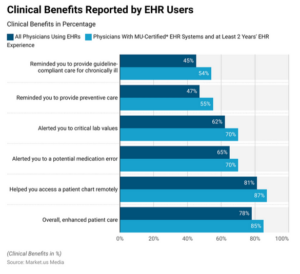
Product Differentiators
As strategic design attributes based upon Kno | bility’s commercial insight:
- Patient authority and engagement centered Interoperability APP; present solutions are post-encounter, attempting to resolve interoperability as part of claims administrative (to exclusion of patient)
- Provider focused CLOUD-Based USER-app; does NOT require system integration (offered)
- NON HIE dependent
- EHR agnostic National Provider Reach; 20% HIE interoperability adoption can have geographic limitations
- Provider and Patient capabilities for HL7 CDA documentation parsing (standard frameworks: 834, 837, etc.)
- Records assessment capabilities: history, condition, treatment and care analysis
MARKET STRATEGY
Go-to-Market Strategy
As a web-APP, the fortunate market advantage of Kno | bility is the functional design, which does not need to sell against much-larger enterprise level EHR, HIE or Interoperability SaaS solutions. Whereby, the strategy for market inception revolves around ground-level (‘grass-roots’) adoption by 1st-hand USERs, i.e. Doctors / Care-Providers / Patients ‘direct-to-consumer’ marketing. Kno | bility’s promotional and sales efforts will revolve around and focus on 1st-hand USERs in a specialized commercial segment, ultimately driving the enterprise solutions business.
Addtionally, the product-value to Providers will drive Patient adoption, as Kno | bility is pre-emptively engaged in care-encouners, invoking “Provider Patient partnership”.
Target Market
1st-person USER’s:
– Providers and Patients Account based (clinicians, offices, specialists, labs, referrals)
– 1st priorities being clinicians and Office-based practitioners w/o mature EHR enterprise infrastructure.
– Targeted focus will be Records Administrators and departments, whom have the most substantive appreciation for the functional value
Competitive advantages:
– NOT selling enteprise system solution against sizeable entrenched vendors
– Adoption NOT impacted by nor dependent upon enterprise prospect SaaS contracts
– Encounter focused, constricted to Clinical Records data
– Ground-level, grassroots adoption drives enterprise Adoption
Stakeholders
Doctors
values: simplicity, reach, timeliness, critical info, medications, records quality
Patients
values: simplicity, reach, authority, control, engagement and governance
Administrators
values: on-boarding, simplicity, reach, timeliness, critical info, records quality
Clinics
values: reach, timeliness, critical info, records quality
Marketing Strategy
Direct to consumer USERs (target), ground-level, grass roots adoption
Office-based
Clinicians
Referrals
Specialized care segments
Acute care
Chronic conditions
Care-provider testimonials
word-of-mouth
Specialized trade campaigns
Channels: journals, groups, associations,
Brand Strategy
Own idea of Encounters (moment)
Records protection and governance
Provider Patient Partnership
Critical info (simplicity, reach, medications)
Records / care quality
(OFFSET infrastructure burden, timely convenient records sourcing)
Brand Concept
A ‘People’ brand (ground level, non-formal, personable), i.e. ‘Provider Patient Partnership’ (per grass-roots adoption).
Un-intimidating technologically and intellectually to USERs; down-playing the complexity of EHR-interoperability.
Simplicity web-APP with NON-insitutional ‘enterprise software’ UI/UX
Empower Providers with enhanced Patient knowledge capability (for optimal patient care and care mgmt admin), i.e. ‘Know powEHR’d Provider App‘
logo:
Descriptive tag:
proprietary pun:
“Know PowEHR’d Provider App.” (play on industry acronym ‘EHR’)
“Real-World, Real-Time Peer Review.”
Brand Identity:
knowledge, idea, enabled

Launch
- Targeted SEO and SEM broadcast launch within specialized channels and domain(s)
- PR announcements and campaign (specialty trade outlets)
- Marketing to Doctors and Administrators
- Test trials and DEMO’s (online, etc.)